
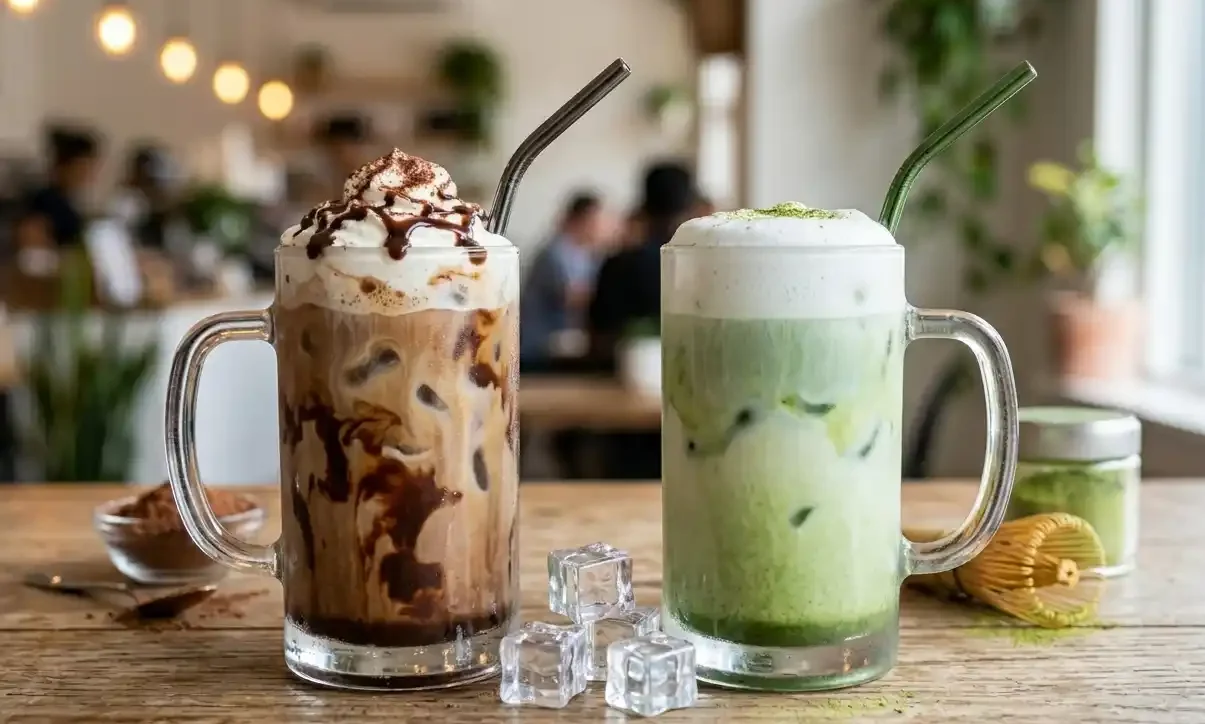
Choosing between iced mocha and iced matcha often looks like a simple preference.
Coffee or tea.
Chocolate or green.
But once you move from cafés to making these drinks at home, the decision becomes more practical than emotional.
It’s no longer about what looks good on a menu.
It becomes about what actually works — repeatedly, consistently, and without frustration.
This is where most comparisons online fail.
They describe flavors.
They don’t test behavior.
This guide is built differently.
It focuses on:
- real preparation experience
- common mistakes
- repeatability
- cost and ingredients
- daily usability
Because in the end, the best drink is not the one that tastes good once — it’s the one you can make well, every time.
Understanding the Core Difference
Before comparing details, it’s important to understand what you’re actually choosing between.
Iced Mocha
A layered drink built on:
- coffee (usually espresso or strong brew)
- milk
- cocoa or chocolate
Its structure is familiar. It behaves like coffee with added richness.
Iced Matcha
A suspension-based drink built on:
- matcha powder
- water
- milk
Unlike mocha, matcha is not dissolved — it is dispersed. This small detail changes everything about preparation.
Taste Profile (Practical Experience, Not Theory)
Iced Mocha Taste
- immediate flavor recognition
- sweet + bitter balance
- chocolate dominates if not controlled
From testing, most people get acceptable results on the first attempt.
Why?
Because:
- cocoa hides mistakes
- milk softens coffee
- sweetness compensates imbalance
Iced Matcha Taste
- subtle
- layered
- sensitive to preparation
Unlike mocha, matcha exposes errors.
If:
- mixed poorly → clumps
- too much powder → bitterness
- wrong temperature → flat taste
It is less forgiving.
Preparation Difficulty (Real Kitchen Conditions)
Iced Mocha
Difficulty: Low
Steps are simple:
- mix
- pour
- adjust
Even without experience, results are usually drinkable.
Iced Matcha
Difficulty: Medium
Requires:
- controlled mixing
- correct ratio
- attention to detail
Without proper technique, quality drops quickly.
Common Mistakes (Based on Real Testing)
Iced Mocha Mistakes
1. Weak Coffee Base
Result: drink tastes like chocolate milk
Solution: use strong coffee
2. Over-sweetening
Result: no depth, no contrast
Solution: reduce sugar, let cocoa balance
3. Low-quality cocoa
Result: flat, artificial taste
Solution: use unsweetened cocoa
Iced Matcha Mistakes
1. Clumping
Result: unpleasant texture
Solution: mix with small amount of water first
2. Too much matcha
Result: bitterness
Solution: start small (1–2g)
3. Cold mixing only
Result: uneven dispersion
Solution: always start with warm water
Ingredients Breakdown
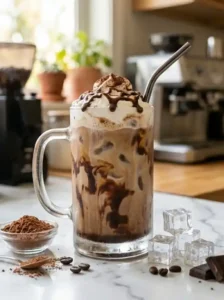
Iced Mocha
- 1 shot coffee (~30–60 ml)
- 200 ml milk
- 1–2 tsp cocoa
- optional sweetener
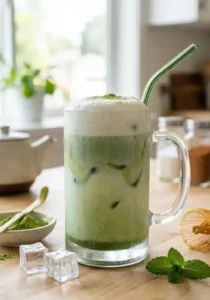
Iced Matcha
- 1–2 g matcha powder
- 50 ml warm water
- 200 ml milk
Cost Comparison (Home-Based)
Iced Mocha
- coffee + milk + cocoa
Average cost per glass: $0.50 – $0.90
Iced Matcha
- matcha + milk
Average cost per glass: $0.70 – $1.20
Matcha appears expensive upfront, but per serving it remains reasonable.
Calorie Comparison
Iced Mocha
- with milk + cocoa
≈ 120–180 kcal
Iced Matcha
- with milk
≈ 80–140 kcal
Lower sugar → lower calories.
Caffeine Comparison (Practical Level)
Iced Mocha
≈ 70–90 mg caffeine
Fast release.
Iced Matcha
≈ 40–70 mg caffeine
Slower release due to L-theanine.
Energy Experience (Real-Life Effect)
Mocha
- fast energy
- noticeable spike
- possible drop later
Matcha
- stable energy
- smoother focus
- longer duration
Tools (Reality vs Assumption)
Mocha
- cup
- spoon
Matcha
- whisk (optional)
- jar (alternative works fine)
Conclusion:
Tools improve experience — but are not required.
Three Practical Methods: Iced Mocha
Method 1: Direct Mix
- mix cocoa + coffee
- add milk
- stir
Best for: speed
Method 2: Shake Method
- combine all ingredients in jar
- shake 10–15 seconds
Best for: smoother texture
Method 3: Layered Version
- milk first
- coffee on top
Best for: visual + control
Three Practical Methods: Iced Matcha
Method 1: Traditional Base
- mix matcha + warm water
- whisk
- add milk
Best for: balanced flavor
Method 2: Jar Shake
- matcha + water
- shake well
- add milk
Best for: no tools
Method 3: Light Blend
- blend briefly
Best for: smooth texture
Daily Use Comparison
| Factor | Mocha | Matcha |
|---|---|---|
| Ease | Easy | Medium |
| Taste Consistency | High | Medium |
| Energy | Strong | Stable |
| Sweetness | Higher | Lower |
| Learning Curve | Low | Medium |
Which One Works Better Long-Term?
From testing patterns:
- Mocha is chosen for comfort
- Matcha is chosen for routine
Why?
Because:
Mocha = reward drink
Matcha = functional drink
Situational Choice (Important)
Choose Iced Mocha When:
- you want something sweet
- you want quick energy
- you want something familiar
Choose Iced Matcha When:
- you want stable focus
- you want lighter feeling
- you want less sugar
Practical Insight Most People Miss
The biggest difference is not taste.
It’s repeatability.
Ask yourself:
Can I make this consistently without thinking?
If yes → it becomes part of your routine.
Improving Consistency (Where Tools Help)
When adjusting:
- milk amount
- sweetness
- powder ratio
Small changes matter.
This is where tools like SpoonCalc help:
- scale ingredients
- adjust ratios
- estimate calories
So each version is not random.
A Personal Note from the Kitchen: The “Clump” Reality
During my first month of daily testing for SpoonCalc, I realized that the biggest enemy of a great Iced Matcha isn’t the price of the powder—it’s impatience. I remember one specific Tuesday morning when I rushed the mixing process; I ended up with bitter, green clumps at the bottom of my glass that were completely undrinkable. On the other hand, with Iced Mocha, my biggest struggle was the ‘watery finish.’ The ice would melt faster than I could enjoy the chocolate, leaving me with a bland, diluted mess. These weren’t ‘café failures’; they were real home-kitchen frustrations. I eventually learned that the secret isn’t in expensive whisks, but in the ’30-second bloom’—giving the matcha or cocoa just enough warm water and attention before adding the ice. That small shift changed my morning from a guessing game to a consistent, professional-grade highlight of my day.
Final Conclusion
There is no “better” drink.
There is only:
- what fits your taste
- what fits your energy needs
- what fits your routine
Mocha is easier to start.
Matcha is easier to sustain.
And once you understand that difference…
You stop comparing them
and start using them.
FAQ
Which is easier for beginners?
Iced mocha.
Which has more caffeine?
Mocha slightly higher.
Which is better daily?
Matcha.
Can I reduce calories?
Yes, adjust milk and sugar.
Can I make both without tools?
Yes.
wish you all the best